Showing posts with label Busan. Show all posts

Tuesday, February 23, 2021

[Food] Gogalbi (Mackerel Ribs, 고갈비)

 [Food]

[Food] Gogalbi (Mackerel Ribs, 고갈비)


In the 1970s, ordinary people and university students in Busan weren't very wealthy. Even though they wanted to eat meat (beef, pork and chicken), it was not affordable for them, though fish was.

Like today, most mackerel in Korea was traded in public fish markets in Busan so citizens enjoyed eating mackerel because it was the most common and least expensive fish (as is the case today). Koreans' favorite mackerel recipe is roasting, so they usually eat roasted mackerel which Busan citizens call 'Gogalbi (Mackerel Ribs)' which is an abbreviation of 'Godeungeo Galbi (Mackerel Ribs)'. Actually mackerel doesn't have any ribs, but Koreans called it 'Mackerel Ribs' because it reminded them of roasted pork rib when mackerels are roasted with thick smoke and plenty of fat.


The Gogalbi recipe was invented in Busan. Its only difference from usual roasted mackerel is that they put some spicy sauce on mackerel for better taste. Gogalbi sauce is usually hot and spicy with lots of spicy chili and garlic.


Moreover, an important thing is that only fresh mackerels must be used for the best taste of gogalbi :) Gogalbi is often salty but gives you a smoky,savory and refreshing taste.

[Food] Gogalbi (Mackerel Ribs, 고갈비)


In the 1970s, ordinary people and university students in Busan weren't very wealthy. Even though they wanted to eat meat (beef, pork and chicken), it was not affordable for them, though fish was.

Like today, most mackerel in Korea was traded in public fish markets in Busan so citizens enjoyed eating mackerel because it was the most common and least expensive fish (as is the case today). Koreans' favorite mackerel recipe is roasting, so they usually eat roasted mackerel which Busan citizens call 'Gogalbi (Mackerel Ribs)' which is an abbreviation of 'Godeungeo Galbi (Mackerel Ribs)'. Actually mackerel doesn't have any ribs, but Koreans called it 'Mackerel Ribs' because it reminded them of roasted pork rib when mackerels are roasted with thick smoke and plenty of fat.


The Gogalbi recipe was invented in Busan. Its only difference from usual roasted mackerel is that they put some spicy sauce on mackerel for better taste. Gogalbi sauce is usually hot and spicy with lots of spicy chili and garlic.


Moreover, an important thing is that only fresh mackerels must be used for the best taste of gogalbi :) Gogalbi is often salty but gives you a smoky,savory and refreshing taste.


Bon Appétit!

Monday, January 20, 2020

[HWPL] HWPL's Western Busan and Gyeongnam Branch Hosted 'The First Peace and Love New Year's Ceremony' for Best Results in 2020

[HWPL]

[HWPL] HWPL's Western Busan and Gyeongnam Branch Hosted 'The First Peace and Love New Year's Ceremony' for Best Results in 2020


The Western Busan and Gyeongnam branch of HWPL (Heavenly Culture, World Peace, Restoration of Light. Chairman Man Hee Lee) hosted 'The First Peace and Love New Year's Ceremony' at Lotte Hotel Pearl Room in Busan District, Busan. More than 150 citizens from Busan participated in the event.

Mr. Jung Su Lee, Director of HWPL's Western Busan and Gyeongnam branch, encouraged peace advocates to work for HWPL's peace initiatives, which includes the DPCW (Declaration of Peace and Cessation of War), Peace Education and WARP (World Alliance of Religions' Peace) Interfaith Dialogue. VIPs working with HWPL also urged citizens to support HWPL and the DPCW.


In particular, Walki Kabir, who is an HWPL peace advocate from Afghanistan National News, emphasized the importance of peace journalism, saying, "Everyone on the earth has responsibility to stop the war for the world peace. As a journalist, it is good chance to spread peaceful message from heaven."

That day, general manager and manager of Western Busan and Gyeongnam branch, delivered a presentation on the branch's 2020 Plan which expressed gratitude for members and VIPs who have been working with HWPL.


My wish is that HWPL and affiliated peace groups will contribute to world peace again this year :)

Peace!


Want to be informed and involved? Click Below!

HWPL official homepage : www.hwpl.kr

IWPG official homepage : http://www.iwpg.org/en/

IPYG official homepage : www.ipyg.kr

Wednesday, June 12, 2019

[HWPL] 525 Peace Walk Event is Photogenic! - Beautiful Photos of 525 Peace Walk Event from Korea

[HWPL]

[HWPL] 525 Peace Walk Event is Photogenic! - Beautiful Photos of 525 Peace Walk Event from Korea


HWPL (Heavenly Culture, World Peace, Restoration of Light. Chairperson: Mr. Man Hee Lee) published an official article about the May 25th Peace Walk Event. Its homepage reported that "the 6th Annual Commemoration of the Declaration of World Peace and Peace Walk" was held under the theme "The World's Call for Peace, Urging Support for the Declaration of Peace and Cessation of War (DPCW)" in 126 cities in 77 countries including Australia, China, Germany, India, Russia, South Africa, the Philippines, and the United States of America.

In Seoul, South Korea, the event was hosted at the Olympic Park with more than 20,000 citizens participating in the "Peace Letter Campaign" to support the DPCW (Declaration of Peace and Cessation of War) with its 10 articles and 38 clauses, urging world leaders to enact the DPCW as legally binding international law.

HWPL (Heavenly Culture, World Peace, Restoration of Light. Chairperson: Mr. Man Hee Lee) also provided beautiful photos of the May 25th Peace Walk Event that was held in Seoul and other cities throughout Korea. Let me show you some of them :)

H.E. Difie Agyarko Kusi, Ambassador of the Embassy of Ghana to Korea
"So, we are counting on you, all those of you who are now in their twenties and thirties, to pick up the mantle and make good on peace.”

Chairman Man Hee Lee of HWPL
".....As the national leaders support the 10 articles and 38 clauses of the DPCW and religions harmonize for peace, the global community can take the road to peace."

Seoul, South Korea

Busan, South Korea

Daegu, South Korea

Changwon, South Korea

Gangwon, South Korea

How beautiful it is when people want to achieve world peace together :) Don't be disappointed that you couldn't participate in the event in Korea or in other countries. You can still take part in world peace and in HWPL's peace campaign :)

I wish that you become a peace advocate too :)


Peace!


Want to be informed and involved? Click Below!

HWPL official homepage : www.hwpl.kr

IWPG official homepage : http://www.iwpg.org/en/

IPYG official homepage : www.ipyg.kr

Thursday, February 7, 2019

[Food] Milmyun (밀면, Cold Wheat Noodle)

[Food]

[Food] Milmyun (밀면, Cold Wheat Noodle)


Milmyun (Cold Wheat Noodle) is one of the famous cuisines from Busan, Korea, originating in the late 1950s after the Korean War. Normally, Korean cold noodle (냉면, Naengmyeon) is made with potato or sweet potato powder for its elasticity and chewy texture but Koreans who decided to stay in Busan having left their hometowns in N.Korea because of the Korean War couldn't get any of the original ingredients for traditional Korean cold noodle. So they figured out ingredients that could replace potato and sweet potato powder for the noodle of Korean cold noodle - flour, supplied by the U.N. Thankfully, and also sadly, Korea was in desperate national poverty so Koreans had to rely on supplies from the U.N. which were corn powder, flour etc. for their own survival. So milmyun (밀면, Cold Wheat Noodle) resulted from North and South Koreans’ nostalgia wanting to taste original Korean traditional cold noodle that they had usually had in their hometown :)

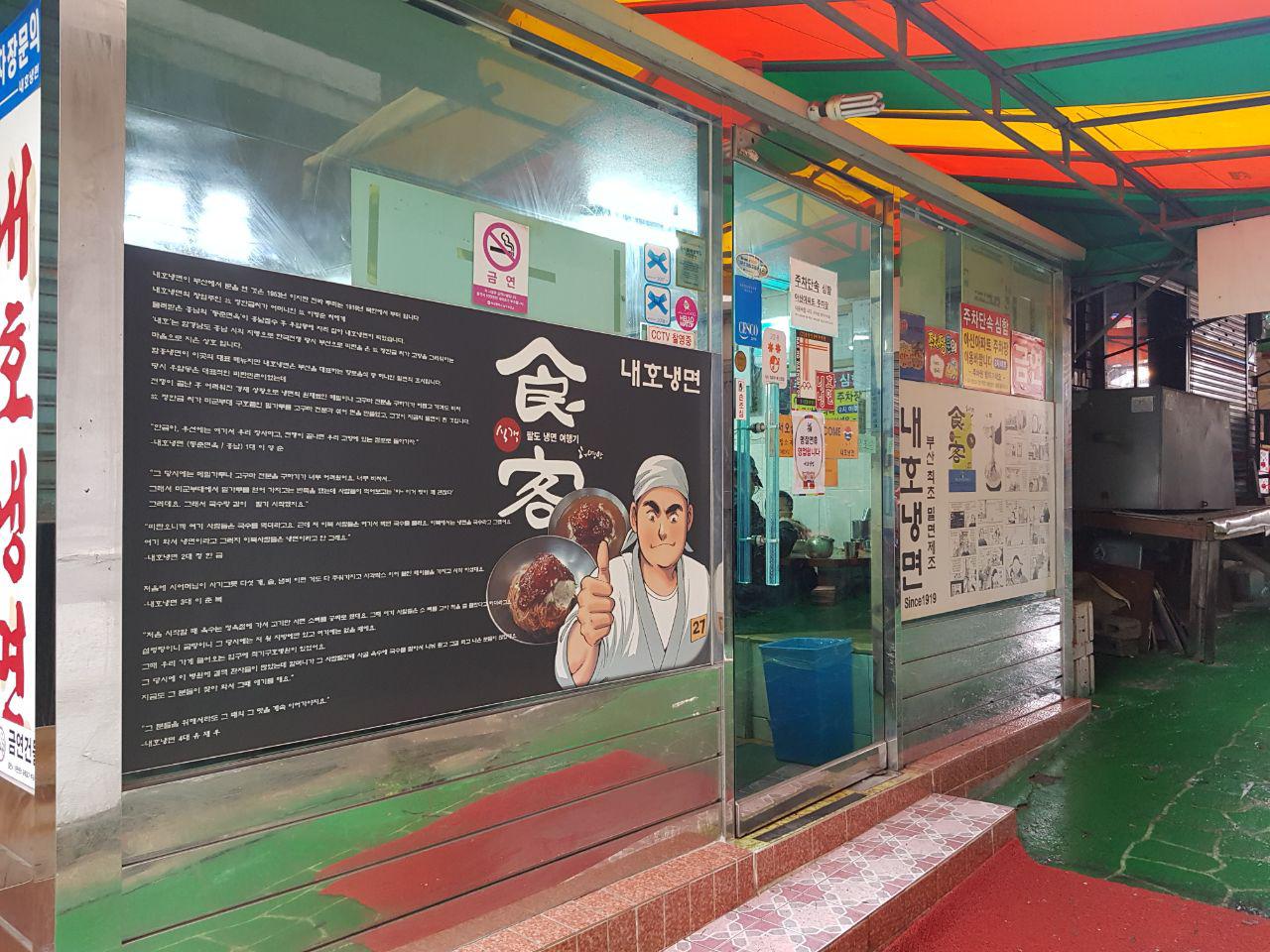
Now milmyun has become one of the main staple cuisines in Busan that has spread across the south-eastern province of Korea. Today's restaurant is Naeho Naengmyeon (Naeho Cold Noodle House) which was founded in 1919 in Busan. The restaurant had achieved great success from the outset, but hadn't re-located because the founder of this restaurant left the following will:


"Stay where I started. Never move anywhere."


So descendants still respect the will of the founder, and the restaurant selling the noodles is where it started. A narrow alley of a small town near a port in Busan.


It became more popular because of a famous gourmet comic book and many gourmet shows on TV. Now :) let's cut the chit-chat here and let me show you what milmyun is :)


Inside the restaurant. Newspapers and posters of gourmet shows decorate the wall :)

Hot noodle soup. It refreshes you when you drink it after a bowl of milmyun :)
Spicy, sour and sweet sauce on top of thin sliced sweet radish, chopped cucumber and sliced pork.


The soup of milmyeon is mild sour, spicy and sweet. I haven't yet met anyone who doesn't like milmyeon (among Koreans). Lapping, elastic and chewy noodles tickle and excite your tongue and gums.  I just can’tt stop eating them, and it makes me drool as I think about its taste :)

Anyway, if you have a chance to visit Busan in Korea, never forget to pay a visit to taste a bowl of milmyun for you :) its unique taste will make you love Busan and Korea more than ever before :)


Bon appétit!

Saturday, October 6, 2018

[Food] Pajeon (파전, Korean green onion pancake)

[Food]

[Food] Pajeon (파전, Korean green onion pancake)


A rainy day in Gangnam (which is famous area for the Gangnam Style), Seoul

Heavy rain has poured down since yesterday, and it is still raining cats and dogs. Personally, I like rainy days with the sounds of rain drops falling on the window pane. It sounds like a xylophone to me :). In contrast, my proud ancestors had likened the sound of rain drops to griddling Pajeon on an iron plate or a pan. I wish I could let you hear it.

Gamasot (Korean iron pot)

Meat is being roasted on a Gamasot (Korean iron pot)

If you were to listen to the sound of something frying on an oily pan, I think you'd understand what they were thinking. So if you ask any Korean 'What food do you think of on a rainy day?' 80% of them would answer 'Pajeon', because their ancestors' thoughts had transcended to the present and reminded them of Pajeon to eat on a rainy day. Pajeon and rice liquor on a rainy day is part of Korean food culture.

Pajeon and Makgeoli (Korean rice liquor)

Pajeon is a well-known traditional food of the Dongnae area in Busan (Yes, the city of Dwaeji Gukbap). The people of Dongnae have planted green onions for so long, and they say that the taste and smell of green onions is different each month (isn't that interesting?), which creates a slightly different taste of Pajeon each month.

Dongnae Pajeon was so popular in the Chosun dynasty (1500 - 1900 A.D.) so people said 'Let's go to Dongnae market to eat Pajeon'.

A view of Dongnae from the Dongnae fortress. Busan was the first city that protected Korea from the Japanese invasion

A traditional building in Dongnae

"Okay, okay. Now stop your explanations Prof. Kim...let's eat, please? Your Pajeon is here."

"Wait, mom. Let me put some sour chili paste for you in a sauce dish."

These days, Koreans usually eat Pajeon with soy sauce, but original Pajeon is traditionally eaten with sour red chili sauce.


I'm in the original Dongnae Pajeon restaurant with my mom. This place is one of my favorite restaurants in Busan despite its cost, because the taste of Pajeon always satisfies me :) Present Korean green onion pancake is usually made with flour, but flour was a very rare ingredient in Korea before the early 20th century...therefore Koreans used rice powder instead. It doesn't make tough dough as much as flour does, but it makes very soft and smooth Pajeon which is very popular for Koreans :) However it is very hard to make Pajeon with rice flour, because it is broken very easily when you try to turn it over due to very little viscosity - compared to flour :(

"No wonder this Pajeon is so expensive...phew" Mom sighed.

"Yes, mom, but the secret traditional recipe and griddling skill justifies the price, I think."

"You can say that if you will pay for it today."

"I think I'd better be quiet from now on."

Shh.....let me tell you some more before I leave....these are ingredients for Pajeon :)

Rice powder

Green onions :)

Clam

Scallop

Oyster
Beef

These are mixed with water, eggs and some more secret ingredients to make Pajeon mixture to be cooked on a pan with special skill that makes un-broken (intact) Pajeon.

Pajeon restaurant and its iron plate

Pajeon with large green onions and chopped squid


There is only one original Dongnae Pajeon eatery in Busan, Korea. I really wish its tradition continues forever :)