Showing posts with label Chicken. Show all posts

Sunday, August 22, 2021

[Food] Yongbongtang (Carp/Softshell Turtle and Chicken Soup, 용봉탕)

 [Food]

[Food] Yongbongtang (Carp/Softshell Turtle and Chicken Soup, 용봉탕)


No one knows when Koreans first cooked yongbongtang (Carp/Softshell Turtle and Chicken Soup, 용봉탕), though the common belief is that it was written in a book and song in 19th century Korea. Given the evidence within 19th century books and songs, food historians in Korea estimate that yongbongtang was first cooked in the latter period of the Chosun dynasty by the royal court and affluent families.

The Chinese character 'Yong(龍)' means 'dragon', and 'bong(鳳)' means 'phoenix', because Koreans likened carp and soft-shell turtle to dragon and old chicken to phoenix. That's how yongbongtang was given its fancy name. Maybe it started in the kitchen of the royal court as food for stamina for the king and the royal family.


One day, Yongbongtang's recipe spread among the common people, and so yongbongtang became native cuisine in some regions and cities. It requires many expensive ingredients, including carp or softshell turtle, old chicken, abalone, intestine, tenderloin, head of the cow, sea cucumber and more. Typical yongbongtang uses carp and old chicken, but the south-eastern city of Gwangju uses a soft-shell turtle and old chicken.

Its recipe is not complicated. As it's 'soup', you just trim, dress and chop ingredients, then throw them into a big pot to boil for some hours. The challenge is dressing carp or soft-shell turtle, which can be a disgusting process for some people.


Yongbongtang tastes similar to typical Korean chicken soup with the scent of herbs, but it has a thicker and more savory meat and marine flavor. There are not many Korean restaurants that cook yongbongtang, and it's very expensive because carp, soft-shell turtle and abalone are all expensive.


If you are looking for exotic stamina food in Korea, yongbongtang might be a good choice for you :)

Bon Appétit! 

Wednesday, July 31, 2019

[Food] Dak-Gangjeong (닭강정, Sweet and sour chicken)

[Food]

[Food] Dak-Gangjeong (닭강정, Sweet and sour chicken)


It is an undeniable fact that famous deep-fried chicken originates from the U.S.A through the tragic history of slavery. Nevertheless, when deep-fried chicken flowed into Korea, Korean-style deep-fried chicken became more famous globbally than the original. (However, it doesn't mean Korea didn't have any deep-fried chicken recipe. Korea had traditional deep-fried chicken recipe called 'Pogye', which is soy-sauce and vinegar-based deep-fried chicken.).

Today's dish, 'Dak-Gangjeong (닭강정, Sweet and sour chicken)', is a very modern Korean dish that appeared from 1970s; the era when Korea was massively industrialized and started to develop its culture, quality and diet. In 1993, dak-gangjeong was introduced in a newspaper as a good dish to cook when deep-fried chicken is left over at home, which means dak-gangjeong was a beloved and popular recipe for the public.

A dak-gangjeong shop in a market of Gangneung Central Market
Dak-gangjeong originated in two cities, Incheon in western Korea and Sokcho in eastern Korea. Several dak-gangjeong shops claim that they have the original dak-gangjeong with 40 years of tradition but no one knows who the original really is.

Dak-gangjeong slightly differs from 'Seasoned spicy chicken' through some of its features, though it is similar. Its seasoning is less watery, more viscous, and fully coated fried-chicken, not 'poured' on chicken. It is usually spicier than seasoned spicy chicken because of garlic and spicy chili, and a bit more crunchy with more nuts.


Western dak-gangjeong from Incheon features bigger chunks of chicken which is very similar to seasoned spicy chicken. On the other hand, eastern dak-gangjeong from Sokcho has smaller pieces of chicken and is usually boned. To me, they are all nice and delicious anyway.

The recipe is very similar to seasoned spicy chicken.

1. Deep-fry chicken pieces.
2. Stir-fry them on a wide and round pan with sliced garlic and spicy chili.
3. Add soy-sauce, starch syrup and water. (Here you can add more seasoning such as chili paste, chili powder etc.)
4. Add starch water and nuts, boil down.


'Dak' means chicken and 'gangjeong' means traditional Korean crunchy crackers with rice, sesame, beans, nuts etc. in Korean. I think that its name suits it very well with its crunchy and sweet features. Dak-gangjeong is one of my favorite dishes, and it is also very popular to many tourists who visit Korea because....I mean, who dare hates deep-fried chicken?! You look at the photos in this article. Don't you see that crunchy, crispy-fried chicken with lip-smacking seasoning?

A dak-gangjeong from Shinpo Market, Incheon, western South Korea

A dak-gangjeong from Sokcho Central Market, Sokcho, eastern South Korea

Nowadays, you can find dak-gangjeong very easily in any market in Korea because it is popular to Koreans and non-Koreans alike. Once I saw tourists from the U.S.A trying some sample of dak-gangjeong at a market in Busan (when I visited Busan), then they bought 2 boxes of dak-gangjeong per person.

A dak-gangjeong with fried rice cake pieces

If you are sick of 'normal' fried chicken, try dak-gangjeong. It will open your door to a new world of deep fried chicken :)


Bon Appétit!

Thursday, June 6, 2019

[Food] Chuncheon Dakgalbi (Korean Chicken BBQ, 춘천 닭갈비)

[Food]

[Food] Chuncheon Dakgalbi (Korean Chicken BBQ, 춘천 닭갈비)


Chuncheon Dakgalbi - Stir-Fried Style

In 1960’s Chuncheon city, South Korea, there lived an owner of a Korean pork BBQ restaurant whose name was Youngseok Kim. He usually sold Korean-style pork BBQ on a charcoal grill, like the other restaurants.

One day, he couldn't buy pork to serve his customers because the stock ran dry in Chuncheon city. So he tried 'Plan B', using chicken instead of pork for charcoal BBQ.

The result? An incredibly successful new menu! That was the day when Chuncheon Dakgalbi (Korean Chicken BBQ, 닭갈비) was invented by Mr. Kim in Chuncheon, South Korea. From then on, Chuncheon's chicken BBQ became increasingly famous and spread throughout the entire country. Today, every Korean thinks of Chuncheon when they hear the word 'Dakgalbi (Korean Chicken BBQ)'.

Myungdong street, Chuncheon, Gangwon province, South Korea

Soyang river, Chuncheon, Gangwon province, South Korea

A street by Soyang river, Chuncheon, Gangwon province, South Korea

However, no one knew the founder of Chuncheon Dakgalbi till Chuncheon city hall researched and reported on Mr. Youngseok Kim’s story. Dakgalbi was originally just simple charcoal chicken BBQ; 'Dak' meaning 'chicken' and 'galbi' meaning 'rib'. But Chuncheon dakgalbi doesn't use chicken ribs (you already know why) but boneless chicken meat such as thigh, breast and tender parts which are chewy, juicy and soft to eat. There are two styles of Chuncheon dakgalbi: char-grill and stir-fry. The Chuncheon people usually eat char-grill dakgalbi, while the rest of Korea enjoys stir-fry.

Both use the same sauce, seasoning and chicken parts, but its taste differs.  The Chuncheon people often use only salt and pepper to season the meat before grilling it.

Char-grilled dakgalbi using Korean chili paste marinated in chicken breast

Char-grilled dakgalbi. It looks a bit more spicy than the above

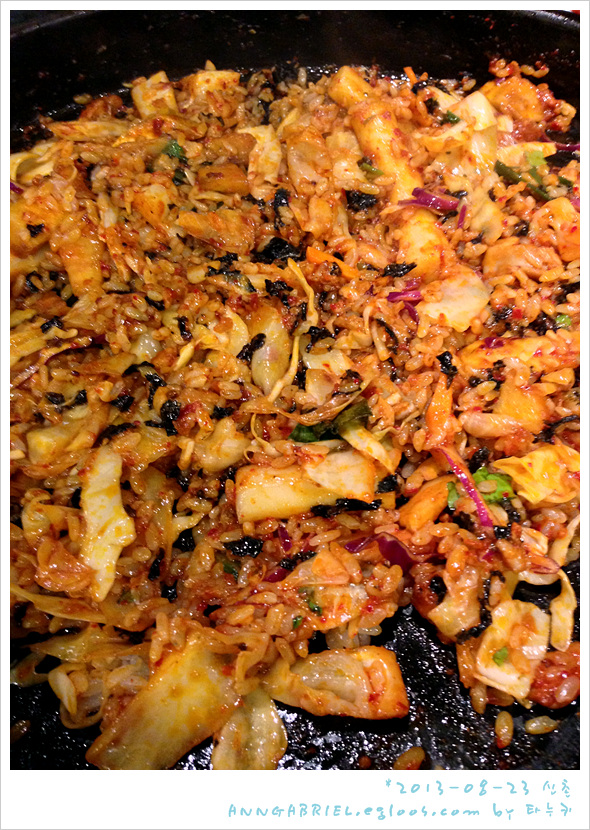
Stir-fried dakgalbi is a little more well-known and common in Korea. It fried spicy marinated boneless chicken with vegetables, sesame leaves, garlic, sweet potato, mushroom and rice cake. Koreans usually add some noodles to the dish, and cook fried rice with its sauce after finishing the meat.

Stir-fried dakgalbi

Dakgalbi sauce with stir-fried rice

Dakgalbi sauce stir-fried rice with kimchi

Chicken, noodle and fried rice! What a delicious dining course :)

If you are planning to visit Seoul, then how about visiting Chuncheon? It's only 40 minutes away from Seoul by train :) Stroll around downtown Chuncheon, go for a drive to Soyang river and Gongji lake, then visit Chuncheon’s dakgalbi street to savor some dakgalbi :) Pack your stuff now.


Bon Appétit!

Friday, May 31, 2019

[Food] Samgyetang (삼계탕, Korean Ginseng Chicken Soup)

[Food]

[Food] Samgyetang (삼계탕, Korean Ginseng Chicken Soup)


As a follow-up article of my previous article on Dakdoritang, I want to talk about another Korean chicken dish. Samgyetang is a very common and traditional chicken dish in Korea. The recipe for Samgyetang first appeared in a Korean document that was published in 1542 when Seboong Ju, who was governor of Pung-gi in Chungcheong province, started to cultivate ginseng from wild ginseng seeds. Samgyetang was produced to energize people through the hot summers.

Whole chicken is cooked for samgyetang

Today, still, Koreans often eat samgyetang in summer to keep a healthy body and gain energy from it. The three hottest summer days in Korea are 'Bok-Nal' (Bok means 'conquer', Nal means 'day', meaning 'the day we conquer the heat'), and there are three Bok-Nal; 'Cho (first) Bok', 'Joong (Middle) Bok' and 'Mal (End) Bok'. So during every Bok-Nal, samgyetang restaurants are crowded with customers eager to fill themselves with energy from samgyetang to conquer the summer heat.

Samgyetang with side dishes
The recipe is very simple. Boil and braise a whole chicken that is filled with sticky rice with ginseng, dates and many other medicinal herbs for several hours till the chicken really softens.

You can taste the deep, thick, meaty chicken stock and silky-soft flesh of chicken. However, non-Koreans who meet samgyetang for the first time may hesitate eating samgyetang because the chicken is explicitly 'nude'.


However, samgyetang is a very healthy food and a good alternative for people who don't like deep-fried or roasted chicken or spicy chicken soup :)

I'm not a big fan of samgyetang, but I usually think of having samgyetang for lunch in summer when it is a blazing hot day or when I'm exhausted.

One of the great things about samgyetang is that you can eat another dish which is chicken porridge (this is why Koreans fill the insides of chicken with sticky rice when they cook samgyetang) after finishing eating the flesh of chicken.


Again, the worst and hottest summer will hit the earth. Koreans will somehow find their way to 'conquer' or 'hide' from the summer heat, and I think I will 'conquer' the summer heat by eating a dish of hot samgyetang with my fellow comrades :)


Bon Appétit!