Showing posts with label noodle. Show all posts

Wednesday, June 26, 2019

[Food] Kong-guksu (콩국수, Cold Bean Soup Noodle)

[Food]

[Food] Kong-guksu (콩국수, Cold Bean Soup Noodle)


Kong-guksu (콩국수, Cold Bean Soup Noodle)

In previous articles, I introduced you to a few dishes that Koreans enjoy in the hot summer such as Naengmyun (Cold noodle), Makguksu (Cold buckwheat noodle) and Samgyetang (Korean Ginseng Chicken Soup).

Today's dish (photo above) is Kong-guksu (콩국수, Cold Bean Soup Noodle), which is a typical Korean summer dish. 'Kong' means Bean in Korean and 'Guksu' means noodle. Its recipe is simple, grind and steam softened beans then mix with some water to prepare a cold bean soup.

Peeled, steamed and softened beans
Korean traditional millstones. Must-have-gear to cook Kong-guksu in the old days before invention of electric grinder.
Personally, I prefer using traditional millstones rather than electric grinders to grind beans into soup because you can taste the whole natural bean flavor. Moreover, you can enjoy the crunchy and nutty flavor from coarsely crushed beans. So some restaurants which use a traditional recipe and millstones put up a signboard that reads, 'Traditional millstone-grounded bean soup', to promote that they have better bean soup.

Cold bean soup from black beans
However, Koreans either love or hate the taste of cold bean soup noodles; fans love it because of its cool, nutty, plain and mild flavor. Those who really dislike it do so because of its fishy, cold bean flavor (some people sense it more than others). Me? I LOVE kong-guksu.

Our Korean ancestors traditionally cooked using beans more than 2000 years ago, passing down excellent tofu and bean-paste recipes from generation to generation. However, the kong-guksu recipe only appeared at the end of 19th century; more than 110 years since now. Its history is the part people get curious about, but no one knows why.


Anyway, people praise kong-guksu with its thick bean soup as the best kong-guksu because of the amount of bean paste put into the soup while some people prefer water-like bean soup. So, a thicker soup means a better cold bean soup noodle :)


This is 'thick' bean soup; it looks like cream-based pasta.

If you are vegetarian or want to taste something unique other than sweet-spicy cold noodle, how about cold bean soup noodle? :)


Bon Appétit!

Sunday, January 20, 2019

[Food] Ramen (라면, Korean Style Instant Ramen)

[Food]

[Food] Ramen (라면, Korean Style Instant Ramen)


Maybe I have told you once before (or not :P), I love rainy days. It's always comfortable and cozy to have a hot spicy ramen and a bowl of rice for supper on such a day. Perhaps I could go out and find any fine Chinese restaurant for a bowl of Zzambbong (Spicy noodle soup that is sold in Chinese restaurants in Korea) instead of ramen, but I decided to make an instant ramen.


I slowly walked to my kitchen and looked for any ramen that might be in the cupboard. I love hot and spicy ramen soup. It fills my body with warm energy and you can feel it twice as much when eaten on a cold day...

I worked in the Korean Army for 5 years before becoming a freelancer. Well...being a soldier in Korea makes you hungry (it doesn't mean Korean soldiers are financially poor or deficient, you would understand what I mean if you joined the Korean Army). Whatever the weather (sunny, rainy, snowy, cloudy, day or night) you work in the Army - drills, training, exercise, office work, being on-guard, patrolling...I remember my colleagues and I were always tired and hungry. We understood we had to be on duty to protect and keep the peace of our country from any foreign threats. As a Korean male, we have to do it whether you like it or not, unless you are physically or mentally unhealthy.

Yeah....it snowed 3-4 meters. I was one of the 'snow-cleaners' too. I had never seen that much snow in my life until then.


I remember the heavy snowy winter season while I was in the Army. Korea experienced its heaviest snow on record in 95 years...and I was there, near the border of South and North Korea - the DMZ (De-Militarized Zone). I was a paramedic at the headquarters of one battalion near the DMZ and got one call from a platoon base which was a bit far away from the headquarters. 

Common instant noodle supply for the Korean Army. Any Korean man in the Army loves this cup-noodle, like I do :)

Ring ring....Ring ring....

"Hello, it's medical corps."

"Sir, it's 00 base, sir. We've got an injured soldier during snow removal, sir."

"Okay, tell me what happened, soldier."

"He accidentally hacked his right shin (bone of leg) with a pickax when he was trying to break frozen snow."

"....Oh..my....poor buddy.....how's his condition now? any bleeding and swelling? can he stand up?"

"No blood, but his leg is swelling so fast. He can't stand up by himself sir."
-Aarrgghhhh! Careful, guys!- (I could hear that poor guy was screaming via phone)

"Okay, lay him down on any stretcher and warm him with a blanket. Tell your platoon leader that we will be there as soon as possible."

I reported the patient to my army surgeon and the battalion commander quickly and picked our medical tool box with the medics on my team. But...

"Sir, how do we get there though? All roads in the area are out of access because of the snow," one soldier asked me. 

Hm...I know that it takes like 40 minutes with the military ambulance to the post...then....

"Then we have to walk on foot. Don't we? Take the sleigh-type stretcher? large splint and...."

My boss (army surgeon) snapped. So the four of us had to walk to the post where the patient was. I remember we took off from HQ at 2 pm and it was almost 4pm when we arrived. He was lucky that it was just a simple fracture, otherwise we would have to call for a medevac. It was a long and hard 'walk' on a snowy mountain on a snowy day carrying all the gear for him - a very unique experience if I weren't in the Army (Ahaha...). Anyway, we safely sent him to a military hospital for greater medical attention and had to walk back home....all the way again :(

A ramen with sliced rice cake and dumplings

After that 'journey' rescuing a soldier who accidentally hacked his leg, we were exhausted, but luckily one friendly staff sergeant who worked in the kitchen of the mess hall, cooked hot-spicy special ramen with dumplings, rice cakes, pork and kimchi, particularly for us.

Oh, we were like 'hallelujah praise the Lord' though we didn't practice any religion at all. Even 5 years later now, I can say that was the best ramen I had ever tasted.


Countless variety of Korean-style ramen

Today, I cook the same ramen with the same recipe that the sergeant cooked for us in the mess hall on that day, but I can't make the same ramen that I tasted. It's such a shame. I'm certain that the ramen on that snowy day was as good as the hardship we endured on that day.

It is now raining heavily (fortunately it doesn't heap up like snow does), so I opened the window a little to listen to the raindrops while I enjoy my ramen :) The sound of raindrops will soothe my lonely heart for sure as I reminisce on my Army days.

I just put this image of cup-noodle because it is one of my favorite ramen. LOL.


Bon appétit!

Sunday, November 18, 2018

[Food] Kalguksu (칼국수, Chopped noodle)

[Food]

[Food] Kalguksu (칼국수, Chopped noodle)


A typical Kalguksu

Grandma became very weak after her bathroom accident. That day, the bathroom floor was very slippery (because of the water) and she fell. She broke her femur and had major surgery.

Well, this accident wasn't the only reason she became weak because she was already over 90 when it happened. It just made us (me and my family) so sad. That's all.

I liked my grandparents. Grandpa was a fishing master and.....grandma was a Korean master chef (to me only, as every grandmother is considered a master chef by their grandchildren.) 

She was good at making almost every Korean food. From Kimchi, Doenjangjjigae, Bulgogi, Tangguk, a variety of herbs, rice cakes, Sikhye (Traditional Korean rice drink) and so on.

I visited my family in Busan last Chuseok (It's like Korean Thanksgiving  Day), and grandma was there too.

"Grandma"

"........."

"Grandma!!"

Wham!

Grandma smacked shoulders as I shouted because she couldn't hear my sound well. I guess my voice had hit her eardrums way too hard.

"Ouch! That hurts, grandma!"

"I'm not deaf, I just can't hear you well...since when have you been here? You almost freaked me out."

"Hehe...just now. You want me to massage your shoulders?"

She grinned.

"Yeah. I've missed your hands, Jerry."

It is such a sad thing to see your loving family getting old and thinking about their death. At every Chuseok or Korean New Year, she always cooked many things with a bag of flour. They weren't luxury or expensive dishes but filled with her love. One of them was Kalguksu (Chopped noodle). 'Kal' means 'a knife' and 'Guksu' means 'a noodle', so Kalguksu means 'A noodle that is chopped with a knife'.

After all the ancestral rites and ceremonies, she kneaded dough with left-over flour and turned them into a bunch of noodles. 6 grandchildren - including myself - loved to watch her cooking and to eat her dish. It was a magical scene for young children. Powder is mixed with water, then it becomes a dough. She had spread dough into wide sheets then rolled them into a cylinder-like shape.

Then they became as you see in the below pictures...


Grandma's magic had turned a simple dough into hundreds of strings :) It was just amazing to me. There are many types of Kalguksu in Korea. Let me introduce them to you :)

1. Kalguksu (Original)


Kalguksu's origin is not certain but it became very common in Korea after 1950 when Korea was supplied with bags of flours and corn-flours after the notorious Korean War (1950~1953 A.D.). Koreans had started producing many noodles with these supplies and flour-made noodles had become a very popular and cheap dish in Korea, instead of rice which was expensive at that time.


Dried anchovy, dried kelp, dried mini shrimps, onion, coarsely chopped garlic and zucchini. They are basic ingredients for original Kalguksu that my grandma used to make for us. The plain but salty flavor of dried sea-food gives a very attractive flavor with plain noodles. I have never seen anyone (including kids) who hate the original Kalguksu.

Kalguksu with perilla powder in it. Personally I like Kalguksu with perilla powder. It has an extra nutty flavor.


Myeongdong Kalguksu. The most famous Kalguksu in Korea. Thick beef stock soup with thin dumplings as the unique feature of the noodle.


2. Manila clam Kalguksu


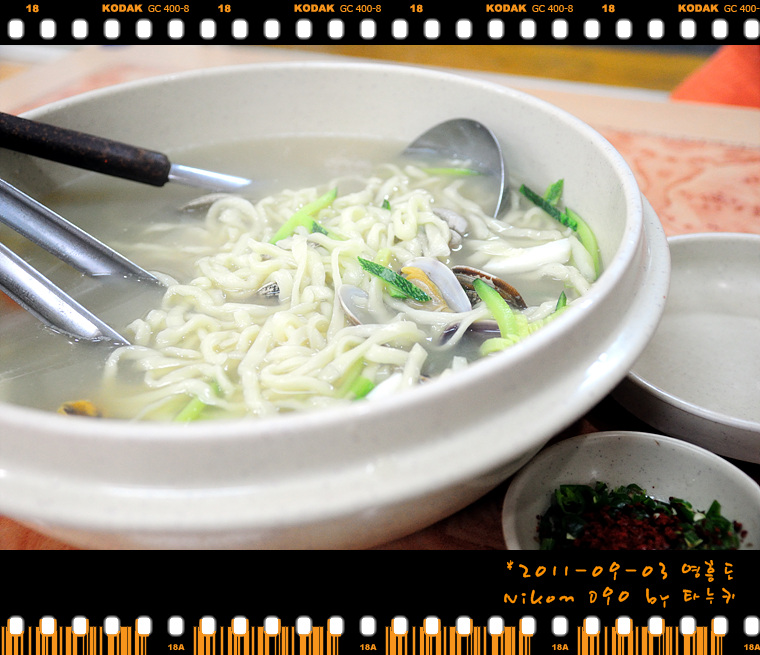
Kalguksu with Manila clam and seafood is usually cooked in the western coastal regions of Korea where it has vast tideland. Clam and seafood stock gives you a very refreshing flavor of the sea (maybe you don't understand this flavor. So you'd better eat it if you have a chance later). It is not a salty or nutty flavor but a unique taste from the sea that refreshes your insides.

3. Chicken Kalguksu


This is another of my favorite kalguksu :) Its deep and thick chicken flavor restores your energy levels. Koreans like to eat chicken kalguksu after finishing Samgyetang (삼계탕, Traditional Korean chicken soup). They just toss ready-made (fresh) noodles into the chicken soup and enjoy it until its last drop

4. Jang Kalguksu (Kalguksu with Red chili / Doenjang(bean paste) )

This Kalguksu is a unique dish in the north-eastern region of Korea only. They put red chili and/or Doenjang (bean paste) into Kalguksu's original soup to give it a spicy and more refreshing flavor. You can taste it in the Gangwon (north-eastern province) region of Korea only in Sokcho, Gangneung, Wonju etc.


5. Red-bean Kalguksu


This is also a very unique type of Kalguksu. People in the south-west region (Jeonra province) of Korea put Kalguksu noodles into red-bean soup and season it with salt (if you prefer the salty taste) or sugar (if you prefer sweetness). I'd rather have a salty than sweet one but my friend from Jeonra province loves the sweet one :P. I think this Kalguksu was made somewhat by chance or something...maybe with a story like, 'someone dropped noodles into red-bean soup and he/she tatsted it. And it tasted really good so they began to make red-bean Kalguksu'....doesn't it make sense? :)


"Jerry, that's enough. That was one fine massage and chat...thank you."

"No worries, anytime grandma. Grandma, do you remember Kalguksu that you usually made for us at Chuseok and New Year?"

"Yes...do you want to have them today?"

I nodded with a big smile, and she laughed.

"Jerry..Jerry...Jerry.....sorry but I have no power to knead or chop dough, kiddo."

"Oh, then I will be your avatar."

"Ava...what?"

"Avatar, grandma. I can cook some, so you just tell me what to do. I will do it instead of you, deal?"

"Deal. Come, help me get up. Take me to the kitchen please, Jerry."

"Sure thing, ma'am."

I took out a paper bag of flour and poured it into a stainless bowl with tap water, and began to do what grandma told me to do. Oh, well, it wasn't easy at all. I had to press, roll, spread, press, roll, spread.....this 'kneading' process kept on going till the dough become tough and soft enough. My arms and hands were so sore as I did weight-training with heavy dumbbells.


Instant Jang Kalguksu
Instant Manila clam Kalguksu

I had never kneaded dough myself before (And also never knew 'kneading' was such a tough job) so I regretted becoming grandma's 'Cook-Avatar' so much.

"Grandma, how did you do this every year? Do you really love cooking?"

"Nah, Jerry."

She smiled.

I remember when she was cooking Kalguksu for us, she seemed to be very happy. 

"I don't understand, grandma. You didn't need to cook them for us, I wouldn't ask you to cook it if I ever knew this was so hard job for you."

"Haha...Jerry. You know nothing."

"duh.........?"

She smiled again. And I began to roll the dough and chop it. Chopping the dough wasn't easy work either.

"What....then....? Why would you do such a thing like this?" I said with grimace. 

She answered.

"Because I loved you, Jerry."

"Pardon?"

"I liked cooking and Kalguksu, but they were not what I loved. I loved you, that's why I cooked. Haha....oh, don't forget to sprinkle some more flour on the chopping board...."

Oh well, I think that I learned something really important from grandma that day.


Bon appétit!

Thursday, October 11, 2018

[Food] Janchiguksu (잔치국수, Korean banquet noodle)

[Food]

[Food] Janchiguksu (잔치국수, Korean banquet noodle)


A Korean traditional wedding


Janchiguksu (잔치국수, Korean banquet noodle)


She wasn't a very special or beautiful girl, she was a very...very ordinary, pretty Korean girl that you see in class. I remember that she had long, slightly curly and dark brown hair with a milky and pale complexion. She was one of the taller people among her classmates. Her big round eyes and cherry-like lips were very attractive to Korean boys like me.

Unlike myself, she didn't like the school where we went. Actually she didn't like to study most subjects i  the curriculum. We had many of the same classes such as chemistry, Korean literature, English literature, physics, physical education, mathematics and so on...I know that she was good at liberal arts, though I, on the other hand, was good at natural sciences.


I had had a major crush on her since I first met her (love at first sight, like other Korean teenagers would have on her), and I never thought she would have the same for me. I couldn't think that this would happen to me because she and I were such different people with different personalities. However, these differences seemed so complimentary.

One Christmas Eve evening, I asked her to be my partner for the Christmas party at school and (surprisingly) she said 'yes', while I was thinking she would surely reject me. From then on, we were officially proclaimed the couple of the school and people said 'You two are a perfect match'.

However, we were too young to last long enough for 'happily ever after'. Radical adolescent emotions and frequent quarrels didn't hold our relationship.

A typical Korean couple


Now, she is holding another man's hand at her wedding on a huge white screen that was set up in a wedding banquet hall. Her groom was one of my alumni who is a successful businessman of a global enterprise.

She sent wedding invitations to all of her alumni from school. When I received her invitation, I was totally stunned and spaced out for several minutes. I couldn't figure out how she had found out my address (maybe Jacky - the president of the alumni association - had told her). I thought that I was absolutely over her, but the invitation recalled unwanted memories.

I came to the wedding with old classmates but didn't stay for the wedding hall. I came down a little early to the banquet hall because I couldn't bear seeing her in a wedding dress with a happy face while I was still single without a partner (Yes, I'm proud to be narrow-minded) but an extra large screen showing the whole wedding ceremony was set up on the wall of the banquet hall as if saying to me 'Ta-dah! I'm here for you'.

A happy modern wedding
Traditional Korean wedding costumes

This whole wedding stressed me out to the ends of the earth. I really wanted to evaporate into the air...and get out of this place. However, the beautiful taste of Janchiguksu took hold of me. Traditionally, Koreans had served their visitors Janchiguksu (잔치국수, Korean banquet noodle) and sweet rice cakes on days of joyful celebration such as a wedding or any party because long strings of a noodle symbolizes 'long healthy life'.

Janchiguksu (잔치국수, Korean banquet noodle)


Sweet rice cake balls (sweet red bean paste in them)

Koreans believe in the oriental five elements theory, and each topping on the noodle symbolizes the color of this theory. Blue (Green zucchini), black (Seaweed or soy-sauced minced beef), red (carrot), white (the white of an egg) and yellow (the yolk of an egg) which all wish the host and visitors a healthy life. Koreans had been eating noodles for a long time and noodles weren't a cheap dish because there wasn't much wheat in the Korean peninsula. So Koreans usually ate noodles on a special day like a wedding and a party for village elders. This is why the noodle was named 'Janchiguksu (잔치국수, Korean banquet noodle)' - 'Janchi' meaning 'party' and 'guksu' meaning 'noodle' in Korean. Today, a bag of flour or noodles is cheap in Korea :)


A typical thin Korean noodle


Thin Korean noodles based on the colors of the five elements
Koreans usually use thin, long noodles to cook Janchiguksu, and usually use anchovy stock. Then the below ingredients...such as....


Eggs are roasted on a pan then chopped into strings


Korean zucchini


Mined meat with soy-sauce


Chopped carrots
Prepared toppings for Janchiguksu
And they usually add some more toppings or a sauce...


Soy-sauce with chopped green onion and chilis


Red chili powder and sesame grind


Koreans love to eat a noodle with kimchi too!

There are many more dishes than just noodle as, these days, the host of a wedding ceremony usually serves a buffet, but enjoy Janchiguksu and rice cakes too much. My mind is saying 'Eat quickly, go home' but my stomach is saying 'Eat, eat, eat, eat....'.


A typical, simple home-made Janchiguksu


Noodles with kimchi, and sweet and spicy sauce
I'm currently eating my 3rd Janchiguksu with a 2nd rice cake dish while thinking to myself that I'm an utterly poor and miserable pig but, honestly, this noodle tastes so good.

Finally, a pastor at the ceremony finished his sermon with a blessing for the wedding couple and allowed the couple to kiss. Well...I think I'd better go now before they come to the banquet hall and thank their visitors for coming to their wedding.


I don't think that I can see their faces with a smile.

It is tradition for the married couple to thank every visitor for coming to the banquet

I hope you live happily ever after...


Well, I'd better forget the past and find a fiancée quickly who will thank the wedding visitors with me...


Bon appétit!